Mostrando entradas con la etiqueta Natural Science. Mostrar todas las entradas

martes, 9 de junio de 2020

NATURAL SCIENCE. ACTIVITY BOOK

Hi children!!

Today we are going to check the homework and the vocabulary.

Activity Book. page 37

Activity 9


Activity 10 


Vocabulary

Bar: barra                                       Morse code: código Morse
Code: código                                    Pulley: polea
Complex: complejo                           Rigid: rígido
Fulcrum: punto de apoyo                  Rope: cuerda
Handle: manija, tirador                   Screw: tornillo
Heavy: pesado                                 Simple machine: máquina simple
Hold: mantener, sostener                Slanted: inclinado, sesgado
Inclined plane: plano inclinado         Steam engine: máquina de vapor
Invention: invento, invención           Surface: superficie
Lever: palanca                                 Tie: atar
Lift: elevar, levantar                      Wedge: cuña
Lower: bajar                                   Wheel and axle: rueda y eje            Machine: máquina
Message: mensaje        


Solo corregid y acordaos de haced el Kahoot.        


lunes, 8 de junio de 2020

NATURAL SCIENCE. KAHOOT

¡Hola a todos!

Aquí os dejo el link para que hagáis el Kahoot de Natural Science. Tenéis hasta el día 11.

https://kahoot.it/challenge/03487237?challenge-id=e1be3ac5-5080-451d-837d-b62ed9512212_1591618678916


 GOOD LUCK!!! ☘

jueves, 4 de junio de 2020

NATURAL SCIENCE.

Hello everyone!!

We are finishing this unit so you have to study it, ok? Next week we will play Kahoot again!!

Let´s check your homowork!

Activity Book. Page 36

Activity 7


Other examples are:
 Horno Microondas 20 Litros Con Grill con Ofertas en Carrefour ...  Microwave

SPC Art Teléfono Inalámbrico Negro  Telephone

Sony presenta su primer coche eléctrico: así es el Vision-S   Car

Renting de ordenador de sobremesa - Oferta  Computer

Activity 8


Please, tomorrow complete Activities 9 and 10 on page 37 on your Activity Book and the vacabulary on page 40. And study the unit!!! 
(estudiad que haremos un Kahoot la semana que viene)

Enjoy your day!!

martes, 2 de junio de 2020

NATURAL SCIENCE. WHAT DID WE USE BEFORE SMARTPHONES?

Hi everyone!!!

How are you today?? Did you do your homework??

Let´s check it!

Activity Book. Page 74

Activity 1


Activity 2

a) Screw
b) Lever
c) Wedge
d) Pulley
e) Inclined plane
f) Wheel and axle

Activity 3


Tomorrow we are going to read and listen to page 74 on your Pupil´s Book.

https://drive.google.com/file/d/1IgQsRiPJOfhFuQ8ZfyyKjeURWiErftZA/view?usp=sharing

WHAT DID WE USE BEFORE SMARTPHONES?

It is very difficult to imagine a world without machines. Inventions begin as an idea and are created later. As time passes, people improve them.

Es muy difícil imaginar un mundo sin máquinas,¿verdad?. Los inventos comienzan como un idea y son creados después. Poco a poco, con el tiempo la gente los modifica y los va mejorando.

STEAM ENGINE / MÁQUINA DE VAPOR

The invention of steam engine started the Industrial Revolution. The engine used water vapour, or steam, to do work. The steam engine powered trains and ships. It also powered machines in factories.

La invención de la máquina de vapor supuso el comienzo de la Revolución Industrial. Utilizaba el vapor para funcionar. La máquina de vapor impulsaba los trenes y los barcos, así como las máquinas de las fábricas. Esto hizo que se fabricara más cantidad y menos tiempo, también mejoro el transporte.

Watch this video to understand it better

TELEGRAPH/ TELÉGRAFO

The invention of the telegraph meant that people could communicate by sending coded messages. It was the fastest way of communicating over long distances.

El invento del telégrafo significó que las personas pudieran comunicarse mandándose mensajes codificados. Era el medio de comunicación más rápido a larga distancia.

Aquí tenéis un vídeo que os explica qué es el telégrafo.


When you have finished, open your Activity Book on page 36 and complete activities 7(escribe para qué usamos cada máquina y pon más ejemplos) and 8.

jueves, 28 de mayo de 2020

NATURAL SCIENCE. Which simple machines holds the door open?

Hello everyone!!!

We are going to continue learning things about simple machines, but first let´s check activity 1 on yor Activity Book, page. 32.


Tomorrow go to page 70 on your Pupil´s Book. Listen and read.

https://drive.google.com/open?id=1EpIyl5DaulImxRY3v805FSIPjFKE4GVC

WHICH SIMPLE MACHINE HOLDS THE DOOR OPEN?

Two more examples of simple machines are a lever and a wedge.

LEVER / PALANCA

It is made up of a rigid bar and a fulcrum. When we push one end of the lever down, the opposite end moves up. It is easier to lift an object when we use a lever.

Está formada por un barra rígida y un punto de apoyo. Cuando presionamos un lado de la barra hacia abajo, el otro lado sube hacia arriba. Así es más fácil elevar un objeto.

Levers: Research Article

WEDGE / CUÑA

A wedge is an object with slanted surface, like an inclined plane. When we push down on the flat part of a wedge, we can cut things easily. We can also use a wedge to stop something moving.

Una cuña es un objeto con una superficie inclinada. Con la parte más plana, el filo podemos cortar cosas fácilmente (la cabeza del hacha tiene forma de cuña). También podemos usarla para parar algo que se mueve, como una puerta o para equilibrar una mesa que cojea.

What is a wedge simple machine

Matthews Track Wedge 399734 B&H Photo Video

You can understand the simple machines better watching this video.


También podéis verlo en español.


Then go to your Activity Book and complete activities 2, 3 and 4 on pages 32 and 33.

See you next week!!

martes, 26 de mayo de 2020

NATURAL SCIENCE. WHICH SIMPLE MACHINE HOLDS THINGS TOGETHER?/ CAN YOU MAKE YOUR OWN CAR?

Hello everyone!!
 
How are you today? Did you do the Kahoot? Remember that the deadline is 28th May!!!

We are going to start a new unit, it is about machines.

Open your Pupil´s Books on page 68. Read and listen.

https://drive.google.com/open?id=1EN0ExA2fm88bpfZOPHDNa_R9eZeL3W5n

1.WHICH SIMPLE MACHINE HOLDS THINGS TOGETHER?

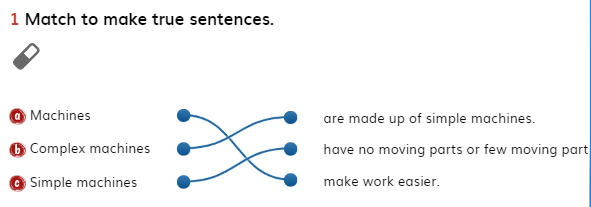
We use machines to make work easier, they help us. There are two types: they can be complex machines or simple machines.

Usamos las máquinas para hacer nuestro trabajo más fácil. Hay dos tipos: las máquinas simples y las máquinas complejas.

Simple machines have no moving parts or few moving parts.

Máquinas simples no tienen partes móviles o tienen pocas.

INCLINED PLANE / PLANO INCLINADO

It is a surface that goes from a low level to a high level. We use it to move heavy objects up and down.
Es un superficie que va desde abajo hasta un nivel más elevado. Gracias a él podemos subir y bajar objetos pesados.

Plano inclinado – simulation, animation – eduMedia

SCREW/ TORNILLO

We use screws to hold things together and also to lift objects.
Usamos los tornillos para unir objetos y mantenerlos unidos.

Conjunto de muebles de madera, fijación de tornillo se atornilla ...            Tornillo R.chapa Din7981 - LOTU - C/200 - 4,8X9,5 MM - 27112

When we put simple machines together, we make a complex machine.
Cuando unimos máquinas simples, formamos una máquina compleja.

Now go to page 70 on your Pupil´s Book. Listen and read.

https://drive.google.com/open?id=1X22kVZWlkwUU8m9bv2GkhGnmxjjH_tcC

2.CAN YOU MAKE YOUR OWN CAR?

A pulley and a wheel and axle are two more examples of simple machines.

PULLEY/ POLEA

We use a pulley when we have to lift or lower something heavy. A pulley uses a wheel and a rope to lift an object.
Usamos una polea cuando tenemos que elevar o descender algo muy pesado. Una polea usa una rueda y una cuerda para elevar un objeto.

Qué es una polea y que tipos existen? - Ingeniería Mecafenix

WHEEL and AXLE/ RUEDA y EJE 

This simple machine is made up of wheel which turns around an axle.We use it to move things across the ground more easily, or to apply force more easily.
Esta máquina simple está formada por una rueda que gira alrededor de un eje. La usamos para transportar objetos por el suelo más fácilmente o para hacer más fuerza.
Taller de Robótica Educativa: Máquinas Simples - Rueda y Eje

Now complete activity 1 on page 32 on your Activity Book.

See you next Thursday!!!

jueves, 21 de mayo de 2020

NATURAL SCIENCE. What is a simple machine?

Hi children!!!

We are going to start the unit 6. We are going to learn what is a simple machine. 

Go to your Pupil´s Book, pages 66 and 67 and let´s start!! We are going to watch the documentary".

En esta nueva unidad vamos a aprender qué es una máquina simple.

Ve a la páginas 66 y 67 de tu Pupil´s Book, vamos a ver el documental "Incredible inventions".


Si no lo veis bien, pinchad en el link.

https://drive.google.com/open?id=14iyuyg2TlkO6wQcGMcWuE709Tt_z9UEC

 And when you have time, click in the following link to check your knowledge about Unit 5. (cuando tengáis tiempo pinchad este link y...comprobaremos si os sabéis el tema 5 jejeje)

https://kahoot.it/challenge/09360037?challenge-id=e1be3ac5-5080-451d-837d-b62ed9512212_1590012196985

Solo tenéis que hacer click en el link y poner vuestro nombre (sin apellidos) en el recuadro donde pone "Enter nickname". Solo hay un nombre que se repite en clase, esas dos niñas ponen su nombre y la inicial de su apellido. Podéis pedir ayuda a papá, mamá o algún adulto que esté con vosotros para acceder pero las preguntas las tenéis que hacer solos, ¡no vale hacer trampa!

Tenéis hasta el día 28 de mayo para hacerlo.

¡Espero que os guste y que os sepáis muchas!


martes, 19 de mayo de 2020

NATURAL SCIENCE.

Hello everyone!!!

How are you? Last day I asked you to study the Unit 5, so please continue stuying it.

And now let´s check your homework...

Activity Book.
 Activity 13. Page 31

I think that the best name for the text is "Taking care of the planet". Do you agree?
Vocabulary. Page 40
Conductor: conductor                  Light energy: energía lumínica
Cool: enfriar                                Liquid: líquido
Dissolve: disolver                         Matter: materia
Electrical energy:energía eléctrica Mixture: mezcla
Energy: energía                            Property: propiedad
Evaporate: evaporar                    Separate: separar
Filter: filtrar                               Shape: forma
Freeze: congelar                          Sieve: tamizar
Gas: gas                                       Solid: sólido
Heat: calentar                             Sound energy:energía acústica
Ice: hielo                                     Thermal energy: energía térmica
Insulator: aislante                       Volume: volumen
Kinetic energy: energía cinética  Water: agua
Water vapour: vapor de agua
 
Next Friday we will play a game and you will answer questions about this unit so...study!!!
El viernes jugaremos a un juego y deberéis contestar a preguntas del tema, así que...¡¡estudiad mucho!!