jueves, 28 de mayo de 2020

NATURAL SCIENCE. Which simple machines holds the door open?

Hello everyone!!!

We are going to continue learning things about simple machines, but first let´s check activity 1 on yor Activity Book, page. 32.
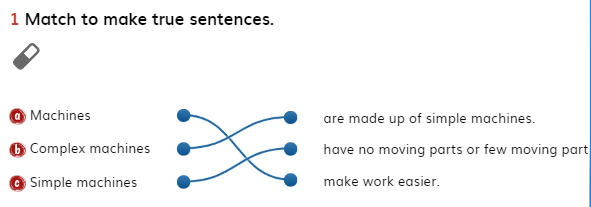


Tomorrow go to page 70 on your Pupil´s Book. Listen and read.

https://drive.google.com/open?id=1EpIyl5DaulImxRY3v805FSIPjFKE4GVC

WHICH SIMPLE MACHINE HOLDS THE DOOR OPEN?

Two more examples of simple machines are a lever and a wedge.

LEVER / PALANCA

It is made up of a rigid bar and a fulcrum. When we push one end of the lever down, the opposite end moves up. It is easier to lift an object when we use a lever.

Está formada por un barra rígida y un punto de apoyo. Cuando presionamos un lado de la barra hacia abajo, el otro lado sube hacia arriba. Así es más fácil elevar un objeto.

Levers: Research Article

WEDGE / CUÑA

A wedge is an object with slanted surface, like an inclined plane. When we push down on the flat part of a wedge, we can cut things easily. We can also use a wedge to stop something moving.

Una cuña es un objeto con una superficie inclinada. Con la parte más plana, el filo podemos cortar cosas fácilmente (la cabeza del hacha tiene forma de cuña). También podemos usarla para parar algo que se mueve, como una puerta o para equilibrar una mesa que cojea.

What is a wedge simple machine

Matthews Track Wedge 399734 B&H Photo Video

You can understand the simple machines better watching this video.


También podéis verlo en español.


Then go to your Activity Book and complete activities 2, 3 and 4 on pages 32 and 33.

See you next week!!

ENGLISH. Listening and speaking.

Hi everyone!!

How are you today? Let´s check your homework...

Activity Book. Page 83

Activity 1


Activity 2


Activity 3


Your answers in the activity three can be different.

Tomorrow we will practice speaking and spelling, open your Pupil´s Book on page 87.


I want yo to notice that when the letters "P" and "H" are together they sound /F/ Now liste and repeat.

PH = F

1.Now listen and repeat.

https://drive.google.com/open?id=1Qygkv86OqVSZ_coqoW_O08kPBvj06KnU

2. Look at the chart. Listen and identify the differences.

https://drive.google.com/open?id=1mhJUachWCaZrqXiKQmJL-70ASSrTAc71

3. If it is possible, practice the dialogue with someone using other examples.

Then go to page 84 on your Activity Book and complete activities 1 and 2.

Have a nice day!!

miércoles, 27 de mayo de 2020

VALORES. ¡ACTÚA!

¡Hola a todos!

    En esta unidad vamos a  ver la importancia del cuidado de la naturaleza. 

    En el cole hemos aprendido mucho sobre este tema ¿verdad? Tenemos 3 papeleras para separar los residuos, intentamos no llevar el almuerzo envasado, procuramos no desperdiciar el agua...

    Vamos a ver un corto sobre el consumo responsable que quizás nos haga ver cosas que todavía no hacemos del todo bien.

    Ya sabéis que el cuidado de la naturaleza es cosa de todos y que cada gesto cuenta mucho y puede tener consecuencias buenas o malas.


Escribid en comentarios vuestra respuesta a las siguientes preguntas:
1.¿Hay algo que no hago y he visto que puedo hacer para cuidar el            planeta?
2.¿Qué es eso que puedo empezar a cambiar?
3.¿Es posible hacer TODO lo que hace el Homo Responsabilus SIEMPRE?

SOCIAL SCIENCE. When did people start using fire?

Hello children!!

Let´s start a new unit that will show us how was the life long time ago.

Open your Pupil´s Book on page 68 and listen:

https://drive.google.com/open?id=1OYNJ1sV5Ap3asvxnlBVE3__MfcJjVGkc

1. When did people start using fire?

Prehistory began with the appearance of the first humans, about 2.000.000 years ago and it ended with the introduction of writing systems, around 3200 BC.
La Prehistoria comienza con la aparición de los primeros humanos, hace unos dos millones de años y terminó cuando se introdujo la escritura, unos 3200 años antes de Cristo.

Prehistory is divided into two periods. La Prehistoria se divide en dos periodos. 

PALAEOLITHIC            AND            NEOLITHIC

* Palaeolithic Period
- Began around two million years ago.
- Comienza hace unos dos millones de años.
- People lived in caves and hunted animals.
- Vivían en cuevas y cazaban animales.
- They used simple tools and controlled fire.
- Utilizaban herramientas sencillas y controlaban el fuego.
- People were nomads, they moved from place to place.
- Eran nómadas, es to quiere decir que no vivían siempre en el mismo sitio, viajaban de un lado para otro.

* Neolithic Period
- Began around 10.000 BC.
- Comenzó alrededor del año 10.000 a.C.
- People began to live in one place.
- Comenzaron a vivir en un lugar fijo, se volvieron sedentarios.
- They farmed crops and kept domestic animals, such as sheep, goats or pigs.
- Cultivaban la tierra y cuidaban animales domésticos como las ovejas, cabras o cerdos.

I let you here this link to watch a video that explains everything.


Then open your Activity Book on page 32 and complete activities 1, 2 and 3.

Si necesitais verlo en español


See you next week!!

ENGLISH. VOCABULARY AND GRAMMAR.

Hello chidren!!!

How are you today? Did you enjoy the story? 

Let´s see the answers...

Activity Book. Page82

Activity 1


Activity 2


Activity 3 

It is your own opinion

Tomorrow we will learn the Vocabulary and Grammar which is on page 86 on your Pupil´s Book.
1. Listen and repeat the vocabulary.

https://drive.google.com/open?id=1gNigyw92UMBgzJLSQVwixJQWNcccSwi0

2.Listen and read the song. Then sing it!!

https://drive.google.com/open?id=1qTTF0E2czAC_PrXMOIqZyATJi0WKu0_L

3. Listen and repeat the sentences. Pay attention to th Grammar Clue.

https://drive.google.com/open?id=1QEpnqPJdlvUKxPNX0NXAMr7uGL3FYQJT

If you need it you can watch again the explanation.


Then open your Activity Book on page 83 and complete activities 1, 2 and 3. 

See you tomorrow!!!

martes, 26 de mayo de 2020

NATURAL SCIENCE. WHICH SIMPLE MACHINE HOLDS THINGS TOGETHER?/ CAN YOU MAKE YOUR OWN CAR?

Hello everyone!!
 
How are you today? Did you do the Kahoot? Remember that the deadline is 28th May!!!

We are going to start a new unit, it is about machines.

Open your Pupil´s Books on page 68. Read and listen.

https://drive.google.com/open?id=1EN0ExA2fm88bpfZOPHDNa_R9eZeL3W5n

1.WHICH SIMPLE MACHINE HOLDS THINGS TOGETHER?

We use machines to make work easier, they help us. There are two types: they can be complex machines or simple machines.

Usamos las máquinas para hacer nuestro trabajo más fácil. Hay dos tipos: las máquinas simples y las máquinas complejas.

Simple machines have no moving parts or few moving parts.

Máquinas simples no tienen partes móviles o tienen pocas.

INCLINED PLANE / PLANO INCLINADO

It is a surface that goes from a low level to a high level. We use it to move heavy objects up and down.
Es un superficie que va desde abajo hasta un nivel más elevado. Gracias a él podemos subir y bajar objetos pesados.

Plano inclinado – simulation, animation – eduMedia

SCREW/ TORNILLO

We use screws to hold things together and also to lift objects.
Usamos los tornillos para unir objetos y mantenerlos unidos.

Conjunto de muebles de madera, fijación de tornillo se atornilla ...            Tornillo R.chapa Din7981 - LOTU - C/200 - 4,8X9,5 MM - 27112

When we put simple machines together, we make a complex machine.
Cuando unimos máquinas simples, formamos una máquina compleja.

Now go to page 70 on your Pupil´s Book. Listen and read.

https://drive.google.com/open?id=1X22kVZWlkwUU8m9bv2GkhGnmxjjH_tcC

2.CAN YOU MAKE YOUR OWN CAR?

A pulley and a wheel and axle are two more examples of simple machines.

PULLEY/ POLEA

We use a pulley when we have to lift or lower something heavy. A pulley uses a wheel and a rope to lift an object.
Usamos una polea cuando tenemos que elevar o descender algo muy pesado. Una polea usa una rueda y una cuerda para elevar un objeto.

Qué es una polea y que tipos existen? - Ingeniería Mecafenix

WHEEL and AXLE/ RUEDA y EJE 

This simple machine is made up of wheel which turns around an axle.We use it to move things across the ground more easily, or to apply force more easily.
Esta máquina simple está formada por una rueda que gira alrededor de un eje. La usamos para transportar objetos por el suelo más fácilmente o para hacer más fuerza.
Taller de Robótica Educativa: Máquinas Simples - Rueda y Eje

Now complete activity 1 on page 32 on your Activity Book.

See you next Thursday!!!

ENGLISH. Story.

Hello everyone!!!

 How are you today? Did you like the story? Let´s see if answer well all the questions.

Pupil´s Book page 84- 85
Activity 1

The secret message is "DOCUMENTARY".

Activity 3
 2. They carry water.
 3. They carry a flag.
 4. They jump over a moving pole.
 5. The red team are the winners.

Tomorrow you have to complete activities 1, 2 and 3 on page 82 on your Activity Book.

This is the link to complete activity 2.

https://drive.google.com/open?id=1ULfoZ3YqbHuF99G-2nnNgjicUOAdrel5